
Remembering
Mother used to tell me that, as a young woman, she walked all the way from the county town to my grandmother’s home—dozens of li, crossing one river after another.
The Tianyu River was one of them.
There were no bridges then, she said. At a small river you rolled up your trousers and waded across; at a big one you needed a ferryman and a boat.
By my childhood, that world had already disappeared. There were fewer rivers, and those that remained had bridges. The ferry crossing on the Tianyu survived only in Mother’s bedtime stories.
But the Tianyu itself was always there. Our home was only five li away, and its waters carried all my childhood memories.
The river rises deep in the Qinling Mountains. In my childhood memory, its broad bed ran from south to north.
A bridge built in the 1970s crossed it—a landmark known to everyone in the surrounding villages.
At the western end stood a shoe factory making protective work shoes sold throughout China. It was one of our town’s best-known enterprises.
In primary school, the national call was to become a new generation with ideals, moral integrity, education and discipline. To show us the vitality of socialist construction, the school took every pupil to visit this model factory.
I still remember us crossing the bridge in a great procession, red scarves tied around our necks, singing “Socialism is good, socialism is good…” We looked like Red Guards setting off on one of their mass journeys.
In those days the most respected workplaces made things everyone understood: sewing-machine parts, farm machinery, flour, paper. They were household names and good places to work. Young men at the post and telecommunications bureau—the predecessor of China Telecom—actually had trouble finding wives.
The most enviable workplace of all, of course, was the supply and marketing cooperative.
This was a time when access to state-rationed grain marked your social status, and buying grain or cooking oil required a ration book and coupons. If you wanted scarce goods—say, a kilo of sugar or a metre of polyester fabric—knowing someone at the cooperative was like knowing someone at the provincial children’s hospital when your child needs emergency care in the middle of the night today.
Mother worked at the cooperative. I can still picture her in those confident, spirited days. Her voice rang out especially clearly then.
I still keep her old employee badge, number 032.
Almost forty years, gone in the blink of an eye.
Memories in Full Colour
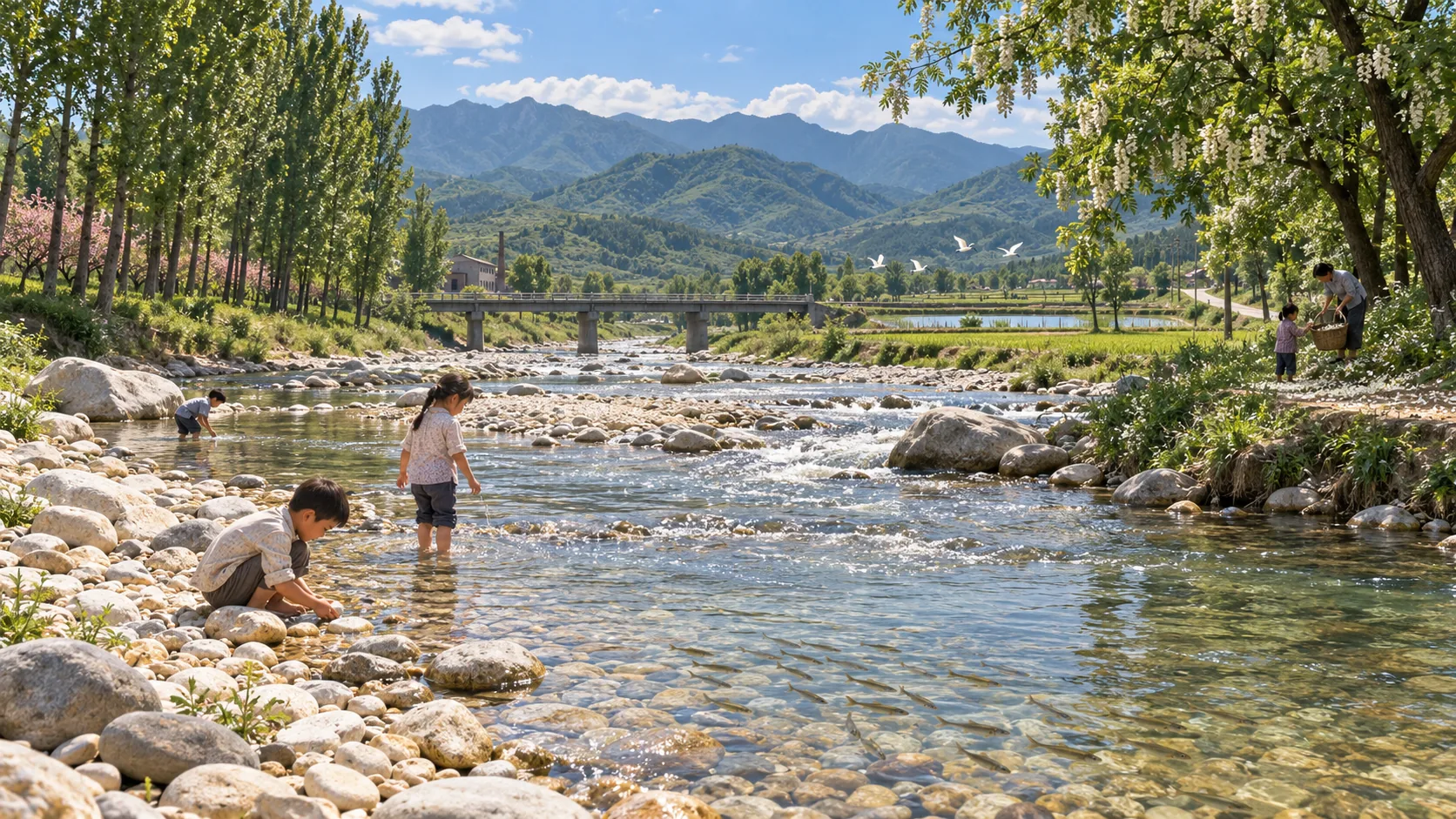
Peach orchards spread along the western bank. On the east, National Highway 108—our only highway then—divided the land in two: fishponds on one side, rice paddies on the other. A true land of fish and rice.
In the ditches beside the paddies, you could easily catch catfish, crabs, leeches and tiny fish no bigger than a finger, as colourful as rainbows.
In late summer and early autumn, white egrets skimmed low. The old poems seemed alive here: egrets before Xisai Mountain, peach blossoms on flowing water and fat mandarin fish; fragrant rice flowers promising a rich harvest, with frogs calling all around.
Tall poplars lined the western embankment. That was where we caught cicadas. Bend a wire into a loop, cover it with spiderweb and fix it to the end of a long bamboo pole: a cicada catcher that hardly ever missed.
On the eastern bank, a path ran beneath black locust trees. When they flowered, the scent travelled for miles. Adults and children alike loved going down to gather the blossoms and steam them with flour.
One mouthful of locust-blossom rice, and May’s fragrance filled your mouth.
After the rains, sheltered pools on the river flats filled with diruan: small, dark brown, jelly-like growths resembling wood-ear mushrooms. We knew them as something that grew only in clean, unpolluted water.
We scooped it up with a strainer, washed and cleaned it, then used it as a filling for steamed buns. Delicious. Bite into one and you could taste the rain.
Locust blossoms steamed with flour, buns filled with diruan: those were the flavours of the Tianyu.
Sometimes, among dead wood and cracks in the riverside rocks, we found huge black beetles with great pincers on their heads. They were as big as a child’s palm and could draw blood from a finger. Even if we got pinched now and then, catching one meant hours of happy play.
Writing this, I looked them up. Only now have I learned that these imposing black creatures are stag beetles. Quite a few people keep them as pets these days.
Hmm. Perhaps I should keep one too.
The Tianyu was full of stones, large and small, in every shape. Some boulders were bigger than a car. There were little white, translucent stones too. Strike two together and beautiful sparks would fly.
White stones and great beetles: toys the Tianyu gave me.
The river was full of fish of every size. Shoals of little ones darted back and forth. Occasionally a few big fish drifted lazily past, two or three together. You could see them all so clearly.
But they were far too quick to catch by hand. If you stood in the water, the little fish weren’t afraid of you. Now and then they nibbled at your legs. It tickled.
That was one of the wonders of the Tianyu in my childhood.
The depth varied. In the shallows, sandbanks broke the surface and you could lie in the sun. Some pools, though, were several metres deep. However hard I dived, I never reached their bottom.
On ordinary days the Tianyu flowed slowly and calmly, like a kind-faced mother. But when the rains came and flash floods poured out of the Qinling Mountains, it became wild in an instant.
Uprooted trees tumbled in the current, branches rising and sinking like the claws of a raging dragon. Anything—or anyone—caught in it could be swallowed in a moment.
Most parents forbade their children to swim there on their own, especially parents employed by the local work units. And children really did drown in the river from time to time.
So whenever we came home from a secret swim, we rubbed saliva onto our arms and legs before going through the door.
If a fingernail no longer left a white mark on your skin, you could insist under questioning that you absolutely hadn’t been swimming. Usually you got away with it.
There were no mobile phones, but if just one of us let something slip, the news travelled fast among the parents. Then a thrashing awaited us at home. Everyone who had sneaked off swimming had to keep quiet.
That was our riverside pact: “We swim together; we face the beating together.”
Sometimes the cover story failed. At school the next morning, we immediately asked one another, “Did your mum hit you yesterday?” If someone had been caught, the rest of us were terrified, scarcely daring to go home.
But however naughty I was, however big a mistake I made, my mother never once hit me.
For children in my hometown more than thirty years ago, the Tianyu was unquestionably paradise.
Even now, I only have to close my eyes: the deepest pool, the thickest sand, the liveliest shoals, the places to scoop up diruan, the richest patches of white stones… I seem to remember them all.
What Has Gone
I don’t know when the locust trees along the banks disappeared.
Sand and gravel operations opened along the river, digging its bed full of holes. The great, strangely shaped boulders were taken away without permission and sold for high prices to companies and business owners, becoming imposing showpieces outside their gates.
The water dwindled too. Bare riverbed spread everywhere, littered with rubbish.
Severely overloaded trucks swayed towards Chang’an, spilling sand and gravel quarried from the Tianyu. National Highway 108 buckled under the weight, its surface pitted and its air thick with dust.
Seeing a solitary, vaguely familiar boulder outside a company gate, I couldn’t help asking, “Stone, dear stone, do you remember me?”
Seeing the towers spring up in the provincial capital, I wondered, “All these grand buildings—what good do they do me?”
A few years ago, on a visit home, a childhood friend took me back to the Tianyu. There was a new bridge and concrete reinforcement along the banks. With the nationwide wave of ecological protection and wetland-park construction, our river had acquired a wetland park too. Swimming, of course, was forbidden.
I could no longer find the deep pool where we used to dive. The river’s beautiful childhood memories, and Mother’s ringing voice, seemed to have vanished like everything erased by a snap of Thanos’s fingers…
Coming Home Through Memory
Last year I went to Slovenia for cross-country flying. After landing, I swam in the famous Soča. I dived beneath the surface and saw shoals of little fish darting about, with two or three bigger ones leisurely flicking their tails. In an instant, the Tianyu of my childhood was before me again…
I miss Mother. I miss those happy childhood days.